
How You Can Actually Face Rejection And Keep Iterating
What I've found after 25+ rejections (and why I'm still pitching)

Everyone says that facing rejection gets easier with time, but that’s not the case for you.
The tenth harsh NO stings just as much as the first one. Maybe more, because now you’ve invested time and effort, and you’re still getting shut down.
But you’re building something, reaching out to people, and that means facing rejection is part of what you signed up for.
So the question isn’t how to make rejection hurt less, it’s how to keep iterating anyway.
I’ve reached out to 25+ founders with my content strategy, and I haven’t been able to close one.
Some of them have given what I call a soft rejection.
They see the reach-out emails, DMs, follow-ups, the content system, but they leave it all on seen.
The second type is hard rejection.
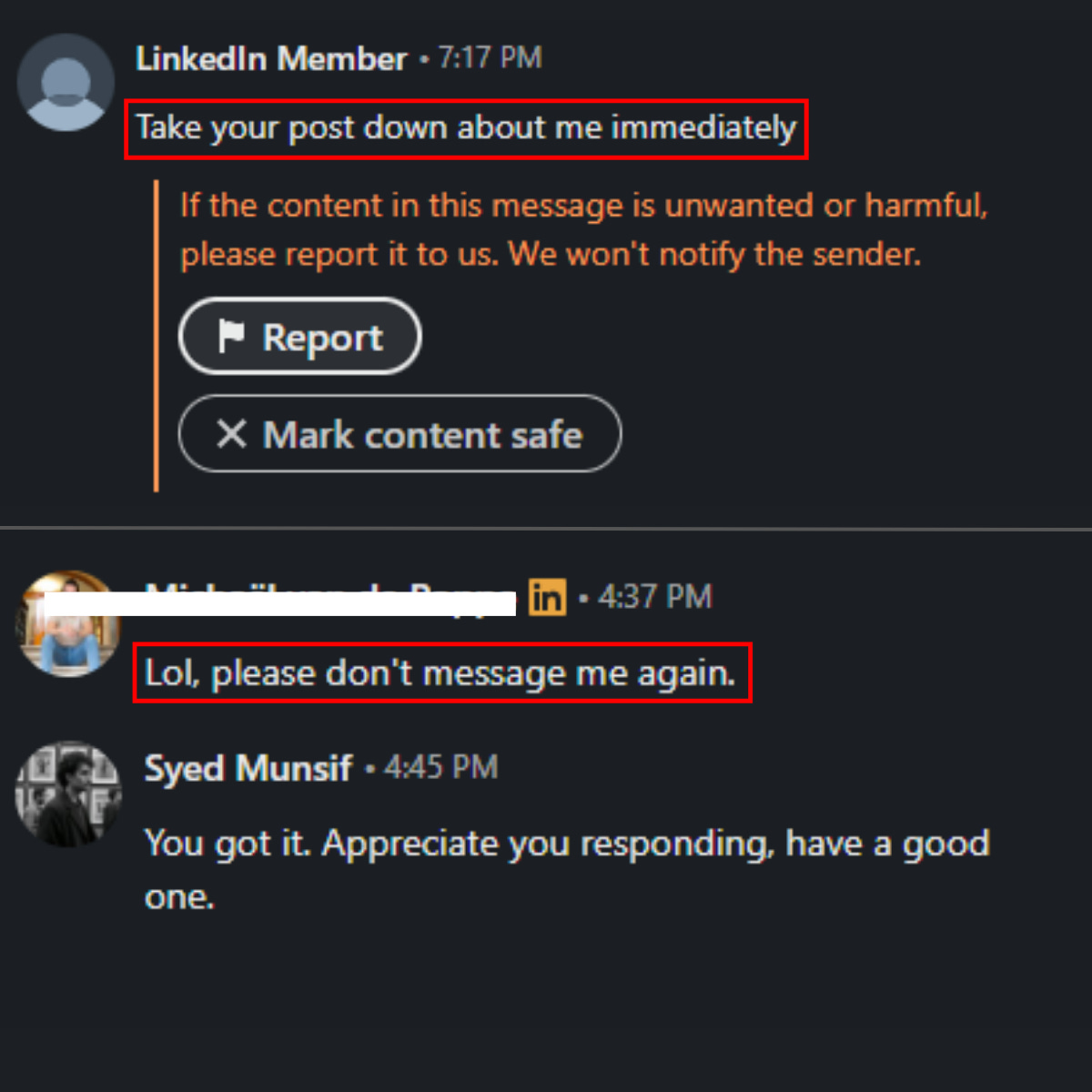
This is when prospects give you the NO and shut the door in your face. Oftentimes, their responses are harsh, so much so that you start evaluating whether to keep doing what you’ve been doing or not.
Both of these rejections are daunting, but the hard rejections sting more, and it is easy for a person to stop after getting one or two.
I have been getting a few of these hard rejections, but I reached out to a prospect just before writing this newsletter.
And trust me, it is not a superhuman ability, but there are a few aspects I’ve found and have cultivated over time that have helped me do this consistently.
Defend What You See
A lot of people say that you should be more open to what people have to say about your thing, and to the advice of others, especially of those who are ahead of you or are where you want to be.
It’s true. You should always be open to feedback and calibrating your approach.
But I believe, when you’re building something you’re convinced about, the problem exists, and people want it, don’t let everyone talk you out of it.
If you can genuinely see it going somewhere, defend it, and work to prove it by making it practical.
You can see the pattern repeating itself.
If Lamborghini had listened to Enzo Ferrari and had gone back to building tractors, we wouldn’t have had the Lamborghini GT.
Or only if Michael Burry hadn’t been confident in his evaluation and hadn’t defended it even after getting rejected by everyone, he and his investors would not have made a fortune in the 2008 housing crisis.
But there’s a thin line between being confident and being stubborn.
If people don’t need it, you can’t talk them into needing it just because you’re stubborn about building it.
The point is, do your due diligence, be open to feedback, make your strategy adaptable, endure the uncertainty, and if you want to quit, it should take you more than just a rejection and hell a lot of convincing.
Because when you quit something to start another thing, you’ll be starting from zero. That’s the cost people don’t talk about when they tell you to pivot after a few NOs.
And you will face the exact same uncertainty, the exact same rejections, just in a different form.
So when a hard rejection makes you question everything, ask yourself this:
Are you questioning the strategy because it genuinely isn’t working, or because you’re uncomfortable with how long it’s taking to work?
It Needs To Mean More
What you’re working towards needs to mean more to you than the fear of rejection or criticism.
When there’s public opinion involved in your work, you will always face criticism, you will always face rejection, but to iterate, you might as well do what you want to do.
Let’s be realistic.
If there isn’t a bigger purpose, you won’t be writing every week for only fifty people to read, reaching out only for your best prospects to ghost you, or building something only for people to laugh at your strategy.
But even if you get rejected a hundred times, and you do it one more time, you will have nothing to lose and everything to gain.
What works even better is when you have a clear understanding of where you don’t want to be.
If you left it all and went on a different available path, would you want to be where it leads?
And what about the current path? You’re facing rejections now, but if it all works out, would it lead to your goals?
That’s what you need to be certain about.
Whether the thing you’re building, if it works, gets you closer to where you actually want to be.
I don’t know if my next pitch will be the one that lands. I don’t know if any of this will work, but I do know what I’m building toward, and I know what path I’m avoiding.
That clarity is what lets me hit send after getting a harsh NO.
What Really Matters
You will face rejection whether you’re building the right thing or the wrong thing. Whether you’re early or late. Whether your approach is perfect or flawed.
So the question isn’t how to avoid rejection.
It’s whether what you’re building is worth facing rejection for.
If it is, you’ll keep iterating.
P.S.: I appreciate you taking the time for this. I couldn’t post this week’s newsletter on Wednesday because of exams and outreach work. Will be posting one on coming Wednesday, though.
P.P.S.: Also, I’ve reached out to my most promising prospect recently. If it works out, it’ll change the direction for the better for me. Will keep you updated.