
How I Tricked My Mind Into Being Consistent (even with what I hated doing)
This is what I found that has kept me consistent for over ten months

“You need to be consistent.”
“Nothing meaningful can be achieved without consistency.”
“Being at it compounds.”
You already know all this.
Yet, when it comes to actually sticking with something consistently, you can’t.
We think it’s out of our reach.
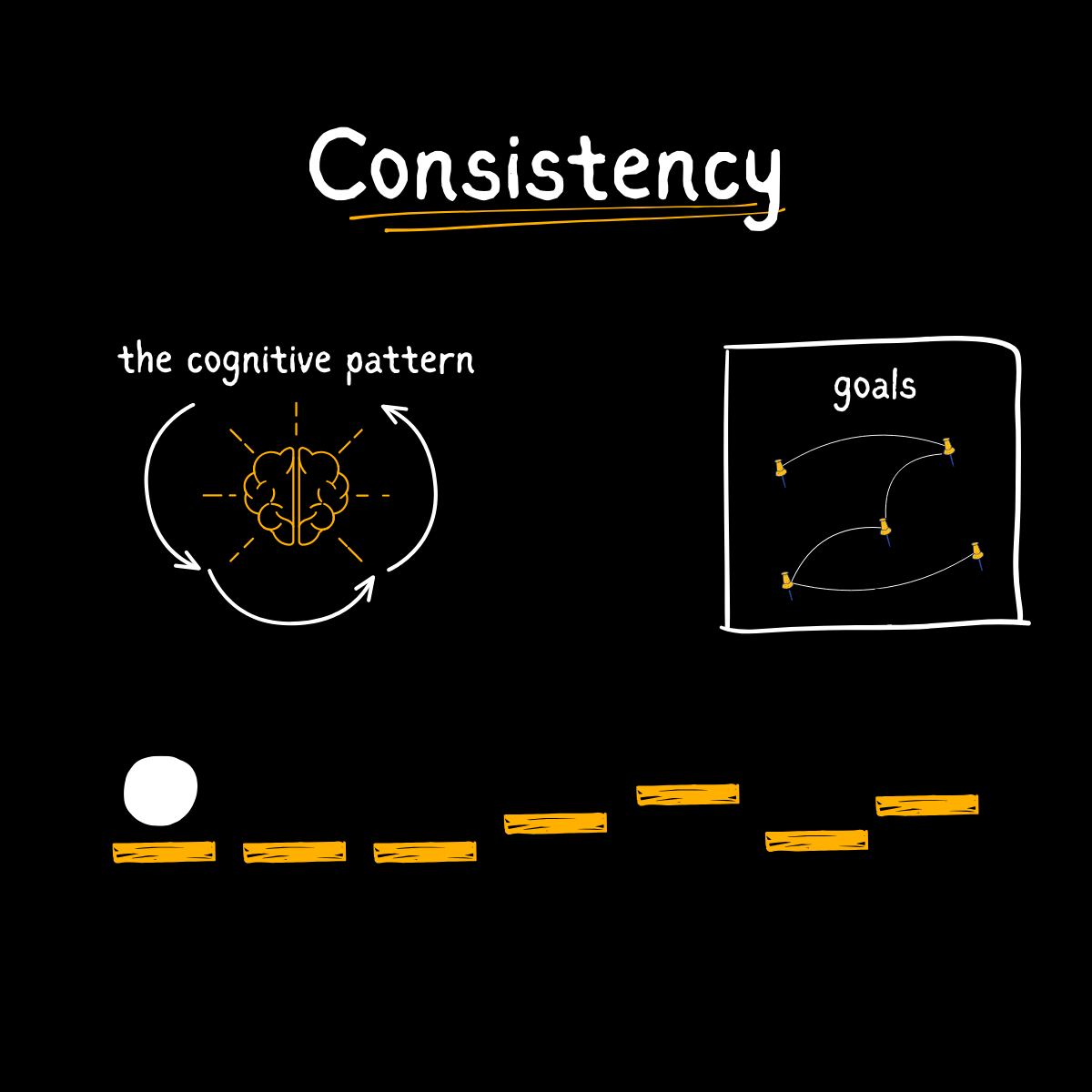
That we need to switch on a cognitive pattern to achieve high-level of consistency.
Or we need certainty of getting outstanding results after being consistent to actually stick with it.
I have been consistent with this newsletter for over ten months now.
I haven’t activated a rare mental path or gotten any visible success (subscribers, followers, $10,000/month), nor do I have certainty that it will work.
Not just with the newsletter, I have been trying to be consistent in school, building my ideas, and recently, cold outreaching founders with my content system.
And I’m leveraging the same pattern I found that kept me consistent here.
What did I find that kept me consistent?
Is a consistent mindset some abstract state of mind?
What can we actually do apart from watching motivational videos or reading about consistency (like this newsletter)?
I’m sharing with you everything that I’ve found.
Apply the strategy by calibrating it for yourself.
Consistency Might Not Be For You
I found this to be the top reason why people think consistency might not be for them.
There’s a lot of advice out there.
The people who found success tell you that they stayed consistent for 3-4 years before they started seeing any results.
You look at the years of work they put in and think you can’t be consistent all these years in something you know nothing about.
You don’t know whether it’ll work for you or not.
I have been consistent for over ten months.
I haven’t found any visible success or what I expected it to be like.
If I knew it would take this long, I wouldn’t have even started, let alone stayed consistent for almost a year.
Many of you might look at my ten-month progress and think,
“He hasn’t been “successful” even after all this.”
“I don’t have a year to put into an experiment. I can’t do it. It is not a priority.”
I know this because this was exactly my thought process.
It, somewhat still, is.
How did I find this pattern, and how to work despite having these thoughts?
The Thinking Loop
I don’t know about you, but whenever something comes up that I’m not familiar with, my mind tells me, it might not be important.
“It doesn’t provide any value.”
“It doesn’t need to be done.”
“I don’t like doing it. (even before I’ve done it)”
Whatever the thing might be, it doesn’t necessarily need to be difficult, just unfamiliar.
I know about this thought process now, and sharing it with you, but for a long time, I believed it.
Just the other day, I was watching a business video.
The person said that he had to do it hundreds of times before getting any results.
My mind immediately went into this thought process.
With these thoughts, my mind tries to keep me “safe”.
You might have this pattern of thinking as well.
The unfamiliarity of the task keeps you complacent.
You stay at a place where you know everything, but your progress keep stagnated.
Now that you understand this pattern, how can you break it?
Do It Before You Know How To
One hack I found to actually take action and start doing.
Do the thing before learning how to do it.
It might seem odd to you, you’ll get it in a minute.
Most of us over-consume knowledge before taking any action.
Now, don’t get it wrong, learning about a subject you want to pursue is really crucial.
One of the reasons I started this newsletter is the book Million Dollar Weekend by Noah Kagan.
When Noah tells you “Now, not how” every day, you’re more likely to take action.
And that really is the point.
You want to start building something, do it before watching a YouTube video about it.
I wanted to build my first web app, but I needed to learn deeper concepts before I could.
So instead of an eighty-video-long C# tutorial, I built a small app with whatever knowledge I had.
And then moved on to watching the complete course, and built & deployed my first web app (Notefied).
You don’t want to be stuck in a loop of ‘How’.
You need to break through the unfamiliarity and take action, instead of just feeling like doing.
You’ve taken the first step.
So, how to turn this into a repeated pattern (consistency), and for how long?
After Taking The First Step
Set a realistic deadline for how long you want to keep the experiment running.
The deadline should be realistic, you can’t just say I’ll be doing it every day at 5 a.m.
After I published my first newsletter, I immediately thought, how often should I be posting?
At first, I thought about posting two times a week.
But soon I realised, it would be really difficult for me to post two times a week while managing other things, maintaining quality, and staying consistent.
So I decided to post once a week every Wednesday.
The same thing happened for my app.
I had a deadline, and I had to submit the project to my professor for evaluation.
So I had to build it before that.
But for how long should it keep going? 2-3 years?
You don’t want to overwhelm yourself with a higher year count.
I started this newsletter as a six-month experiment.
Six months, every Wednesday, one newsletter.
Set an optimal period to determine how long you should be doing it.
And after six months?
When the experimental phase passes, and you don’t find the success you were looking for, then what?
I’m telling you this from experience.
Once it passes, you will find something that will force you to keep going.
You will discover things that your curiosity won’t let go of.
That’s when you will decide you want to keep on going.
The final piece you need to keep yourself consistent, even when what you’re doing doesn’t make any sense.
Tie To Your Bigger Goals
Take the mundane tasks that require consistency, and tie them to your eventual goals.
Even with all this, you will hit a phase where you will have no idea why you’re doing it.
It’s an eventuality.
Writing a newsletter consistently every Wednesday doesn’t make sense.
Even if I miss one time, no one would even notice.
Why take all the trouble?
When this eventual question of uncertainty arises,
“Why am I even writing this newsletter?”
“Why am I building this?”
Remind yourself of the bigger goals it is tied to.
No one would notice if you aren’t being consistent.
But you will. And your bigger goals will suffer from it.
You’re only accountable to your future self.
And it is counting on you.
How I’m Using The Strategy Now
It isn’t something I discovered and moved on from, and I’m only writing this to share results with you.
This is an ongoing process, and I will find more things as I move forward.
I’m using it to be consistent in cold outreach and pitching my content system to entrepreneurs.
My mind kept telling me that cold outreach is not worth it.
I identified the thought pattern that it’s telling me this because I’m not familiar with it.
I pitched to a few founders before I knew anything about the cold outreach.
Now, I’m learning about it, watching Hormozi’s videos (he’s the best), and improving on it.
Since I’m pitching with the value upfront (building the complete content strategy for whom I’m pitching), I can’t outreach to hundreds of founders every week.
So I’ve set the target to 7-10/week (deadline) until I get my first client.
And this mundane task of building a complete content strategy for a founder, who will most likely not respond (uncertainty), is tied to my bigger goals.
The goal of building a SaaS and, eventually, a creator business.
If I struggle with consistency in the future, I will revisit this newsletter as well.
I have broken down the complete pattern that has worked for me, and I’m still experimenting with it.
You have the framework, but you need to apply it yourself, in your own way.
You will discover a lot more that will work for you even better.
Maybe you could share that with me. 🤝
P.S.: I pitched 6 entrepreneurs with my content system strategy.
Got response from zero.
I will make it work.
If you want to know the content system I’m pitching to entrepreneurs, I have created a complete blueprint to break it down.
Subscribe (from this newsletter so I’ll know), and I’ll send it to you.
You can comment if you’re already subscribed.